
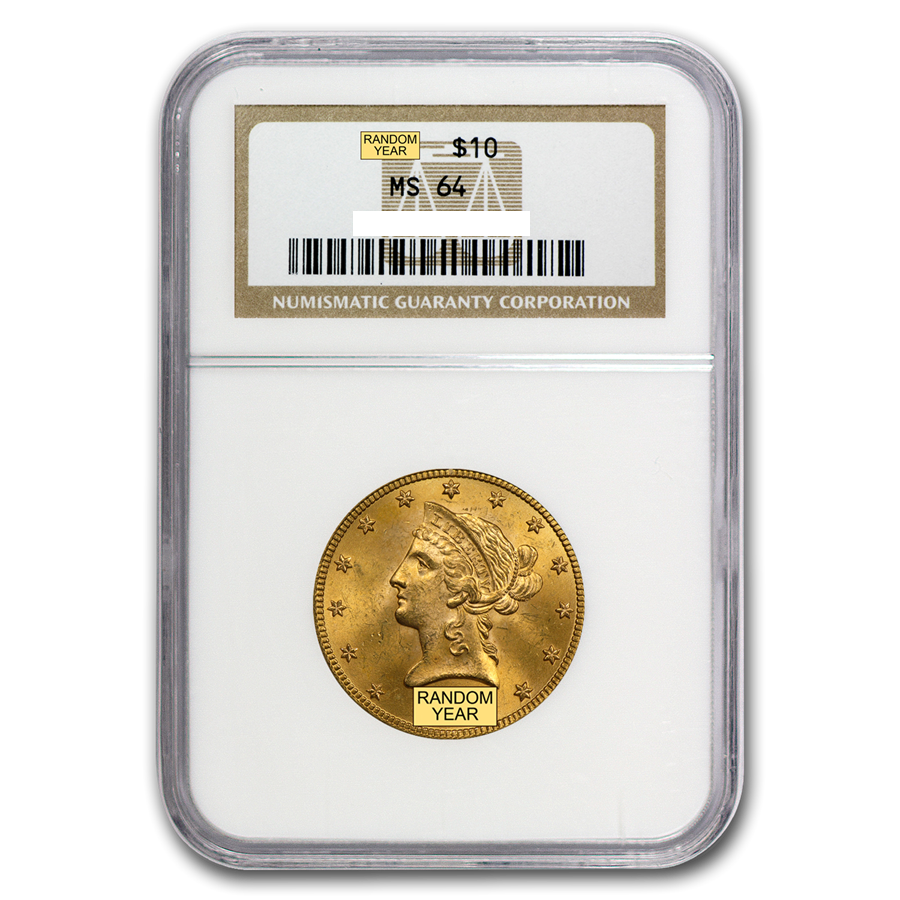
$10 Liberty Gold Eagle MS-64
The $10 Liberty Gold Eagle MS-64 is a classic piece of American gold coinage that combines historical significance, intrinsic gold content, and collectible condition. Also known as the Liberty Head Eagle or Coronet Head Eagle, the $10 gold coin was struck by the United States Mint from 1838 through 1907. Designed by Christian Gobrecht, it features a distinctive portrait of Liberty on the obverse and a heraldic eagle on the reverse. 1909-O $5 Indian NGC AU55
An $10 liberty gold eagle MS-64 example is especially appealing to collectors because it remains in Mint State, meaning it does not have the wear associated with circulated coins. The combination of an original 19th- or early-20th-century design, 90% gold composition, and high-grade preservation makes the MS-64 Liberty Eagle an important type of pre-1933 U.S. gold coin.
What Is a $10 Liberty Gold Eagle?
The $10 Liberty Gold Eagle is a United States gold coin with a face value of ten dollars. It was introduced in 1838 after the earlier Classic Head Eagle design and remained in production until 1907. The Liberty Head design was created by Christian Gobrecht, who served as the third Chief Engraver of the U.S. Mint. Any Date $2.5 Indian Gold Quarter Eagle MS65
The coin contains approximately 0.4838 troy ounce of gold and is composed of 90% gold and 10% copper. It measures approximately 27 mm in diameter and has a reeded edge. ARC Saint-Gaudens Double Eagle MS64 1907-1933
$10 Liberty Gold Eagle Specifications
| Feature | Details |
|---|---|
| Denomination | $10 |
| Series | Liberty Head Eagle |
| Years Minted | 1838–1907 |
| Designer | Christian Gobrecht |
| Composition | 90% gold, 10% copper |
| Gold Content | Approximately 0.4838 troy oz |
| Diameter | Approximately 27 mm |
| Edge | Reeded |
| Grade | MS-64 |
| Type | Pre-1933 U.S. gold |
Individual dates and mintmarks can have substantially different mintages, survival estimates, and collector values, so the specific year and mintmark are important when evaluating an MS-64 Liberty Eagle. ARC Saint-Gaudens Double Eagle MS63 1907-1933
What Does MS-64 Mean?
MS-64 stands for Mint State 64 on the standard Sheldon grading scale. A Mint State coin has no circulation wear, although it can show small marks, hairlines, or other minor imperfections from production, handling, or storage.
For a $10 Liberty Gold Eagle, an MS-64 grade indicates a well-preserved example with strong overall eye appeal relative to circulated specimens. Certified examples graded MS-64 by professional services such as PCGS or NGC are typically encapsulated in protective holders with the coin’s grade and identification information.
The difference between MS-63, MS-64, MS-65, and higher grades can have a significant effect on collectible value. For this reason, the numerical grade should be considered alongside the coin’s date, mintmark, strike quality, surface preservation, rarity, and certification.
$10 Liberty Gold Eagle Design
Obverse
The obverse features a left-facing portrait of Liberty wearing a coronet inscribed “LIBERTY.” Thirteen stars surround the portrait, representing the original states of the United States, with the date positioned below.
The Liberty portrait and coronet are among the most recognizable characteristics of the Coronet Head Eagle series.
Reverse
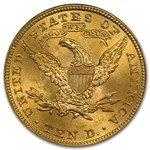
The reverse displays a heraldic eagle with a shield, surrounded by inscriptions identifying the United States and the denomination. Depending on the date and design type, collectors may encounter differences in the reverse design and the presence or absence of the motto “IN GOD WE TRUST.”
The motto was added to the $10 Liberty Eagle in 1866, creating an important distinction between earlier No Motto issues and later With Motto examples.
Liberty Head $10 Gold Eagle Types
The long production period of the Liberty Head Eagle means collectors encounter several major design periods. These include the early Liberty Head issues beginning in 1838, the New Style design, and later examples featuring the motto IN GOD WE TRUST.
The series also includes coins struck at different U.S. Mint facilities, including Philadelphia, New Orleans, and San Francisco. Philadelphia coins generally have no mintmark, while coins produced at branch mints can carry identifying mintmarks.
Because production lasted nearly seven decades, rarity varies considerably from one date and mintmark to another. Some early issues are particularly scarce in high grades, while certain later dates are encountered more frequently.
Why Is an MS-64 Liberty Gold Eagle Collectible?
Several characteristics contribute to the appeal of an MS-64 $10 Liberty Gold Eagle:
- Historic U.S. gold coinage: These coins were produced during an important period of American monetary history.
- Long-running design: The Liberty Head Eagle was struck from 1838 through 1907.
- Gold content: Each coin contains approximately 0.4838 troy ounce of gold.
- Mint State preservation: MS-64 examples retain their original uncirculated condition.
- Numismatic interest: Date, mintmark, rarity, and grade can all influence collector demand.
- Classic design: Liberty and the heraldic eagle remain recognizable symbols of early U.S. coinage.
The combination of precious-metal content and historical character makes the series relevant to both gold collectors and numismatists.
How Much Is a $10 Liberty Gold Eagle MS-64 Worth?
The value of a $10 Liberty Gold Eagle MS-64 depends on more than its $10 face value or gold content. Important factors include the date, mintmark, grading service, population, rarity, eye appeal, and current gold market.
For example, certified MS-64 Liberty Eagles from different dates can have significantly different market prices. Current dealer listings demonstrate that MS-64 examples from individual dates can trade for premiums above their underlying gold value.
Collectors researching the value of a particular coin should therefore identify:
- The coin’s year.
- The mintmark, if present.
- Whether it is a No Motto or With Motto variety.
- The grading service.
- The numerical grade.
- The coin’s certification number when applicable.
- Recent comparable sales or dealer pricing.
A generic value estimate is less useful without the exact date and mintmark.
MS-64 vs. Lower-Grade Liberty Gold Eagles
Condition is one of the most important variables in collectible coin pricing. Circulated Liberty Eagles can show varying degrees of wear on Liberty’s portrait, the coronet, stars, eagle, shield, and other high points.
An MS-64 Liberty Eagle has no conventional circulation wear because it is graded within the Mint State range. However, it may still exhibit small contact marks or hairlines consistent with the grade.
As the grade increases, surface preservation and overall eye appeal generally become increasingly important. Scarce dates can command substantial premiums even when comparing coins with the same numerical grade.
$10 liberty gold eagle Coin Highlights:
- Gold Content: Contains .4838 troy ounces of pure gold.
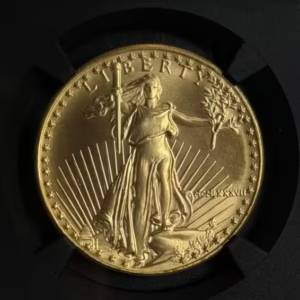
- Certified Condition: Authenticated and encapsulated by NGC, ensuring its MS-64 quality.
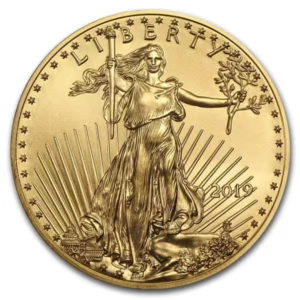
- Obverse Design: Features Lady Liberty, encircled by 13 stars, with “Liberty” inscribed on her hair band.
- Reverse Design: Displays a majestic heraldic eagle with a shield on its breast, surrounded by “United States of America” and the denomination.
- Guaranteed Authenticity: Struck and backed by the U.S. Mint.
Own a Piece of American Gold History
Enhance your Pre-1933 Gold collection with this highly sought-after $10 Liberty Gold Eagle.
Order now to secure this historic gold coin
Reviews
There are no reviews yet.