How Do You Clean Ancient Roman Coins? A Safe Guide for Collectors
If you have recently acquired an ancient Roman coin, you may be wondering, how do you clean ancient Roman coins without damaging them? Unlike modern coins, Roman coins can be hundreds or even thousands of years old. Dirt, mineral deposits, corrosion, and natural patina may all be present on the surface. how do you clean ancient roman coins 1904 $20 Liberty Head MS62 Prooflike
The most important principle when cleaning an ancient Roman coin is to preserve the original surface rather than trying to make the coin look new. Aggressive cleaning can permanently remove historical details and may negatively affect a coin’s collectibility. how do you clean ancient roman coins ARC 1 oz Silver Bar – Random Design
In this guide, we’ll explain how do you clean ancient roman coins carefully, what methods to avoid, and why professional conservation may sometimes be the safest option. Ancient Silver Coins of Alexander The Great
Why Are Ancient Roman Coins Difficult to Clean?
Ancient Roman coins have spent centuries exposed to burial environments, moisture, minerals, and chemical reactions. Depending on the coin’s metal and burial conditions, it may have accumulated different types of surface material.
Common substances found on Roman coins include:
- Loose dirt and soil
- Mineral deposits
- Surface encrustation
- Oxidation
- Corrosion products
- Natural patina
- Residue from previous cleaning
The challenge is determining what should be removed and what should be preserved.
how do you clean ancient roman coins, A layer that looks like dirt may actually be a stable patina or part of the coin’s original surface. 2026 Silver American Eagle
How Do You Clean Ancient Roman Coins?
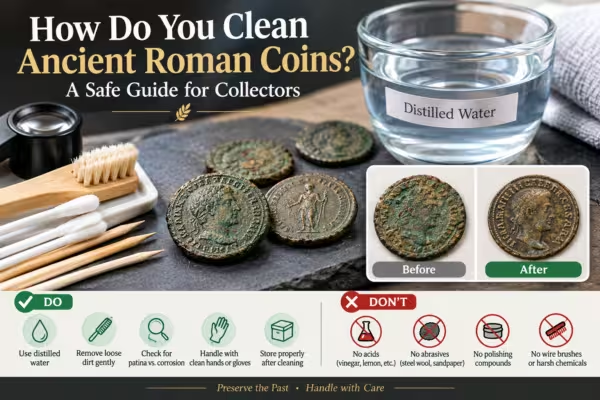
The safest approach is to begin with the least aggressive method possible.
1. Examine the Coin Carefully
Before doing anything, inspect the coin under good lighting. Look for inscriptions, portraits, reverse designs, mint marks, cracks, corrosion, and areas of exposed metal.
If the coin is potentially rare or valuable, consider having it identified and evaluated before attempting any cleaning.
2. Remove Loose Dirt Gently
If the coin is covered with loose soil, a gentle cleaning process may be appropriate.
A conservative approach can involve:
- Rinsing the coin with clean water.
- Allowing loose dirt to soften.
- Gently removing material that comes away easily.
- Rinsing again if necessary.
- Drying the coin carefully.
Do not force deposits that remain firmly attached to the surface.
3. Use a Soft Brush With Caution
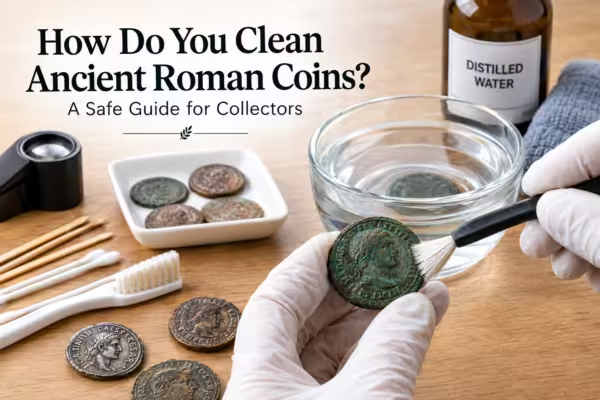
A very soft brush may help remove loose particles after soaking or rinsing.
However, brushing should never become aggressive scrubbing. Ancient coin surfaces can be fragile, particularly when corrosion has weakened the underlying metal.
If brushing begins to remove the actual surface of the coin, stop immediately. how do you clean ancient roman coins 1823 Capped Bust Half Dollar MS63
4. Dry the Coin Thoroughly
After water cleaning, the coin should be dried carefully. Avoid vigorous rubbing.
The goal is to remove moisture without scratching or disturbing the coin’s surface.
Should You Remove Patina From an Ancient Roman Coin?
Usually, you should be very cautious about removing patina.
Patina is a layer or coloration that develops naturally on metal over time. Ancient Roman bronze coins, for example, can develop attractive brown, green, or other surface tones.
For collectors, patina can be an important part of an ancient coin’s appearance and history.
Removing it can expose underlying metal and create an unnatural-looking surface.
Do not assume that a darker or discolored ancient coin needs to be polished. how do you clean ancient roman coins 1803 Draped Bust $1 Small 3 VF20
What About Green Corrosion on Roman Bronze Coins?
Green material on a bronze Roman coin deserves particular attention.
Some green coloration may simply be stable patina. Other green corrosion products may indicate ongoing corrosion that can continue damaging the coin.
Because these conditions can look similar to an inexperienced collector, aggressive removal is not recommended.
If a valuable Roman bronze coin appears to have active corrosion, professional evaluation and conservation may be appropriate. how do you clean ancient roman coins 1872 Philadelphia Liberty Head $5 Gold Half Eagle – NGC AU55
How Do You Clean Ancient Roman Silver Coins?
Ancient Roman silver coins should also be treated conservatively.
Silver can develop natural toning and surface changes over time. While a heavily tarnished modern silver coin might tempt someone to use silver polish, the same approach should not be applied to an ancient coin.
Avoid polishing ancient Roman silver coins.
Polishing can create scratches, remove original surface material, and give the coin an unnatural appearance.
The darker color of an ancient silver coin is not necessarily dirt. how do you clean ancient roman coins Ancient Silver Coins of Alexander The Great
Can You Use Vinegar to Clean Ancient Roman Coins?
Using household acids such as vinegar is generally not recommended for ancient coins.
Acidic substances can react with metal surfaces and potentially remove patina or alter the coin’s original appearance.
The same caution applies to other household cleaning products. A method that works for modern household objects may be inappropriate for a historical artifact.
Can You Use Baking Soda on Roman Coins?
Baking soda is abrasive when used as a polishing agent. Rubbing it against an ancient coin can scratch the surface and remove material that collectors may consider important.
For that reason, using baking soda as a DIY polishing method is best avoided.
What Cleaning Methods Should You Avoid?
When cleaning ancient Roman coins, avoid aggressive techniques that can permanently change the surface.
These include:
- Metal polish
- Silver polish
- Steel wool
- Sandpaper
- Wire brushes
- Strong acids
- Abrasive powders
- Household chemical cleaners
- Aggressive scraping
- Mechanical polishing
- Grinding tools
These methods may remove dirt, but they can also remove the coin’s original surface.
Once that material is gone, it cannot be restored simply by cleaning the coin again. how do you clean ancient roman coins 1987 $50 American Gold Eagle NGC MS70
Can Cleaning Reduce the Value of an Ancient Roman Coin?
It can.
Ancient coin collectors often care about original surfaces, patina, detail, and overall preservation. A coin that has been aggressively cleaned may have scratches, exposed metal, or an unnatural surface.
The impact on value depends on the individual coin, its rarity, condition, authenticity, and the extent of the cleaning.
This is one reason experienced collectors generally approach ancient coin cleaning conservatively. how do you clean ancient roman coins 1 oz Platinum American Eagle BU (Random Year)
Cleaning vs. Conservation
It is useful to understand the difference between cleaning and conservation.
Cleaning focuses primarily on removing dirt or deposits.
Conservation focuses on preserving and stabilizing an artifact while minimizing unnecessary changes to its original condition.
For an inexpensive coin with loose dirt, careful basic cleaning may be reasonable. For a rare or valuable ancient Roman coin, professional conservation may be a better choice. how do you clean ancient roman coins Does an Older Coin Automatically Mean It’s Worth More?
When Should You Avoid Cleaning an Ancient Roman Coin?
There are several situations where cleaning yourself may be unnecessary or risky.
Consider leaving the coin untouched if:
- It appears rare.
- It has an attractive natural patina.
- It contains significant corrosion.
- The surface is fragile.
- You are unsure what the deposits are.
- The coin may have significant collector value.
- You can already see important inscriptions or details.
- You suspect the coin has been previously cleaned.
In these cases, obtaining advice from an experienced ancient coin dealer, numismatist, or professional conservator may help prevent irreversible damage.
How Should You Handle Ancient Roman Coins?
Proper handling is just as important as cleaning.
Whenever possible, hold an ancient coin by its edges rather than repeatedly touching the obverse and reverse surfaces.
Keep coins away from:
- Excessive moisture
- Harsh chemicals
- Abrasive materials
- Unstable storage environments
- Unnecessary handling
Appropriate storage can help preserve the coin’s surface after conservation or cleaning.
What Makes Ancient Roman Coins Valuable?
Cleaning is only one part of caring for an ancient Roman coin. Collectors may also consider:
- Authenticity
- Historical significance
- Emperor or ruler
- Mint
- Date or period
- Denomination
- Metal
- Rarity
- Condition
- Surface quality
- Patina
- Provenance
A worn Roman coin can still be historically fascinating, while a well-preserved example may have substantial collector interest.
Frequently Asked Questions
How do you clean ancient Roman coins at home?
For coins with loose dirt, begin conservatively with clean water and gentle handling. Avoid aggressive brushing, scraping, polishing, acids, and household chemicals. If the surface is fragile or the coin may be valuable, professional advice is preferable.
Should I polish an ancient Roman coin?
No. Polishing can scratch the coin and remove its original surface or natural patina. Ancient coins generally should not be treated like modern circulation coins.
Is it safe to soak ancient Roman coins?
A gentle water-based approach may be appropriate for some coins with loose soil, but not every ancient coin should be soaked. The coin’s metal, condition, corrosion, and surface should be considered first.
How do you remove dirt from ancient Roman coins?
Loose dirt can sometimes be removed through gentle rinsing and careful handling. Stubborn deposits should not automatically be scraped away because they may be attached to or part of the original surface.
Can you clean a Roman bronze coin?
Some Roman bronze coins can be carefully cleaned, but bronze is particularly vulnerable to corrosion. Green deposits should be evaluated carefully before attempting removal.