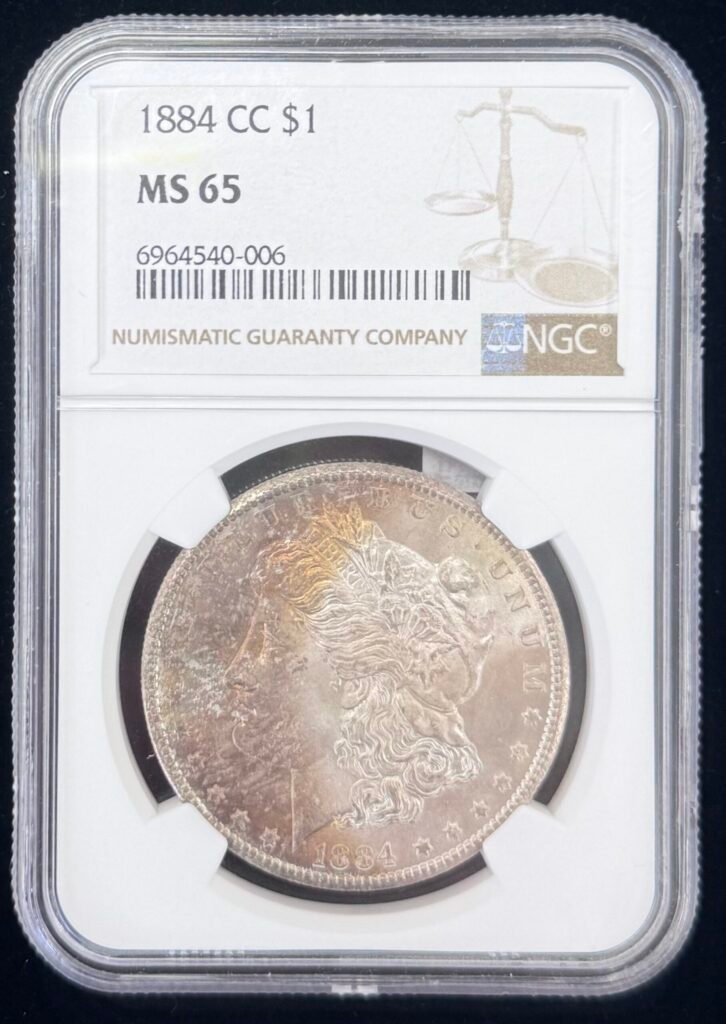
1884 CC Morgan Silver Dollar Value: Price Guide, Rarity & What Makes It Valuable
The 1884-CC Morgan silver dollar is an important Carson City issue that attracts collectors because of its history, silver content, and connection to the famous Carson City Mint. While more than one million examples were originally struck, the number of surviving coins in different grades varies considerably. 1884 Carson City Morgan Dollar NGC MS65
So, how much is an 1884 CC Morgan silver dollar worth? The answer depends heavily on condition, certification, surface quality, strike, toning, and whether the coin has a desirable designation such as Prooflike (PL) or Deep Mirror Prooflike (DMPL). 1884 cc morgan silver dollar value 1883-CC Morgan Silver Dollar PCGS MS63
This guide explains the 1884 CC Morgan silver dollar value, mintage, grading factors, recent auction examples, and what to look for if you own one.

Quick 1884 CC Morgan Silver Dollar Value Overview
The 1884-CC Morgan dollar was struck at the Carson City Mint in Nevada. The issue had a mintage of 1,136,000 coins. It contains 90% silver and 10% copper, weighs 26.73 grams, and has a diameter of 38.1 mm. 1884 cc morgan silver dollar value 1883 cc morgan silver dollar value
Current retail and market references show that examples can range from several hundred dollars in circulated or lower uncirculated grades to thousands of dollars for exceptional certified coins. For example, APMEX currently lists examples around $395 for Fine-12 and around $420 for MS-63, while its displayed values rise substantially at higher grades. 1884 cc morgan silver dollar value 1883-cc Morgan Silver Dollar PCGS MS67 – CAC Certified – Toned
| Condition | General value indication* |
|---|---|
| Fine to circulated | Around $200–$400+ |
| AU / About Uncirculated | Around $300–$500+ |
| MS-60 | Around $250–$350+ |
| MS-63 | Around $300–$500+ |
| MS-65 | Around $1,000+ |
| MS-66 | Around $1,000–$2,000+ |
| MS-67 | Several thousand dollars |
| Exceptional PL/DMPL | Can reach several thousand dollars |
| Top-grade auction specimens | $10,000+ possible |
*1884 cc morgan silver dollar value, These are broad market indications, not guaranteed selling prices. Coin prices fluctuate based on grade, certification, appearance, auction demand, and marketplace. 1878-cc Morgan Silver Dollar PCGS MS66
Why Is the 1884-CC Morgan Dollar Special?
The “CC” mintmark on the reverse identifies the coin as having been struck at Carson City. Carson City Morgan dollars are particularly popular among collectors because of the mint’s history and relatively limited production compared with the Philadelphia, New Orleans, and San Francisco Mints.
In 1884, Carson City produced 1,136,000 Morgan dollars. By comparison, Philadelphia produced 14,070,000, New Orleans produced 9,730,000, and San Francisco produced 3,200,000 Morgan dollars that year.
The 1884-CC is therefore a distinct collectible variety rather than simply another 1884 Morgan dollar. 1884 cc morgan silver dollar value 1878-CC Morgan Silver Dollar PCGS MS63
1884-CC Morgan Dollar Mintage
The official circulation-strike mintage was:
1,136,000 coins
That figure is important when considering the historical scarcity of the issue. However, mintage alone does not determine today’s value.
One of the unusual characteristics of the 1884-CC Morgan dollar is its survival rate. PCGS research notes that approximately 962,638 coins—about 84.7% of the original mintage—were still held by the U.S. Treasury in 1964.
Large numbers were subsequently released, including through the General Services Administration (GSA) sales.
As a result, the 1884-CC can actually be relatively common in Mint State grades even though well-worn circulated examples can be surprisingly difficult to find. Stack’s Bowers describes worn examples as uncommon while noting that Mint State coins remain readily available. 1884 cc morgan silver dollar value 1878-CC Morgan Silver Dollar PCGS MS63 CAC Approved
What Does the “CC” Mean?
The CC stands for Carson City, referring to the United States Mint facility in Carson City, Nevada.
For Morgan dollar collectors, the mintmark is extremely important because it distinguishes the Carson City issue from coins struck at other facilities.
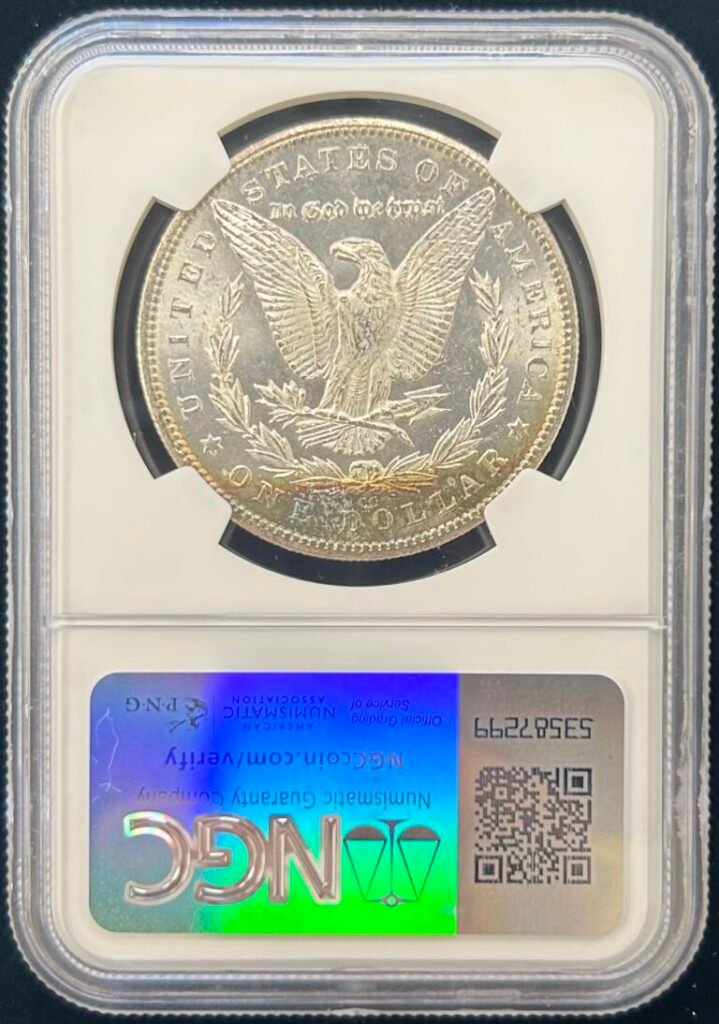
You can find the CC mintmark on the reverse, beneath the wreath and above the denomination.
An 1884 Morgan dollar without the CC is a different coin and should not be valued using an 1884-CC price guide.
Factors That Determine 1884 CC Morgan Silver Dollar Value
1. Coin Grade
Condition is one of the biggest factors affecting the value of an 1884-CC Morgan dollar.
A heavily circulated coin with significant wear generally commands much less than a sharply preserved Mint State specimen.
Professional grading uses a numerical scale, generally ranging from Poor (PO-1) through Mint State (MS-70) for business-strike coins.
For an 1884-CC Morgan dollar, grades such as MS-63, MS-64, MS-65, MS-66 and MS-67 can represent substantially different market values.
2. Surface Marks
Morgan dollars were transported and stored in large quantities, which means many examples developed bag marks.
Small marks may be acceptable for the grade, but heavy abrasions across Liberty’s face, cheek, fields, or other prominent areas can reduce desirability.
PCGS notes that many 1884-CC examples in the MS-60 through MS-63 range have noticeable bag marks.
3. Luster
Original mint luster can make an 1884-CC Morgan dollar particularly attractive.
Collectors generally look for strong, natural-looking luster rather than an artificially bright or heavily polished appearance.
4. Strike Quality
Strike quality also matters.
An attractive 1884-CC Morgan dollar may display well-defined design details, while weaker examples can have softness in some areas.
5. Toning
Natural toning can sometimes add collector appeal, particularly when the colors are attractive and the surfaces remain original.
However, unusual or suspicious-looking toning can have the opposite effect.
6. Prooflike and Deep Mirror Prooflike Designations
Some 1884-CC Morgan dollars have Prooflike (PL) or Deep Mirror Prooflike (DMPL) characteristics.
These coins can command premiums when the mirrors, contrast, and overall preservation are strong.
Recent auction records demonstrate how significant these designations can become at higher grades. Greysheet, for example, records a 2026 sale of an 1884-CC MS-67 PL for $6,100.
1884-CC Morgan Dollar Value by Grade
There isn’t one fixed price for every 1884-CC Morgan dollar.
Instead, think of value as a progression based on preservation.
Circulated 1884-CC Morgan Dollars
Circulated coins show visible wear on Liberty’s portrait and the reverse design.
Interestingly, circulated 1884-CC dollars can be harder to find than Mint State examples because so many of the original coins spent decades in government storage rather than circulating heavily.
A circulated example may be worth several hundred dollars depending on its exact grade and eye appeal. 1884 cc morgan silver dollar value 1881 cc morgan silver dollar value
About Uncirculated (AU)
AU coins have only slight wear on the highest points of the design.
An attractive AU example can be considerably more desirable than a heavily worn specimen, particularly if it retains good luster and has clean surfaces.
MS-60 to MS-62
Mint State coins show no circulation wear, although they can have significant marks or other imperfections.
PCGS estimates that hundreds of thousands of 1884-CC Morgan dollars survive in MS-60 through MS-62 grades.
A 2025 Stack’s Bowers auction example graded MS-60 by NGC sold for $264.
MS-63
MS-63 represents a more desirable Mint State level.
PCGS auction records include several NGC MS-63 1884-CC Morgan dollars that sold for $288 in November 2024, while PCGS’s displayed price-guide figure on those listings was $425.
This illustrates an important point: price-guide estimates and actual auction results are not necessarily the same.
MS-64 and MS-65
As the grade rises, surface quality becomes increasingly important.
MS-65 coins are significantly more desirable than typical lower-grade Mint State examples. PCGS estimates that approximately 30,000–35,000 MS-65-or-better examples may exist.
At these levels, small differences in marks, luster, strike, and eye appeal can produce substantial differences in price.
MS-66 and MS-67
High-grade 1884-CC Morgan dollars can become expensive.
APMEX currently displays an MS-66 example around $1,179 and an MS-67 value of approximately $5,000 on its 1884-CC pricing page.
Auction records show that exceptional coins can sell for considerably more.
Stack’s Bowers reports an NGC MS-68 1884-CC Morgan dollar that sold for $29,375, while another PCGS MS-67+ example sold for $19,800.
These exceptional results should not be used as a typical value for an ordinary 1884-CC Morgan dollar.
1884 CC Morgan Silver Dollar Auction Records
Auction results provide useful evidence of what collectors have actually paid for specific coins.
Some documented examples include:
- MS-60 NGC: $264 in March 2025.
- MS-62 NGC: $288 in November 2024.
- MS-63 NGC: $288 in November 2024.
- MS-63 NGC: $312 in June 2024.
- MS-67 PL NGC: $6,100 in June 2026.
- MS-67+ PCGS: $19,800 at Stack’s Bowers.
- MS-68 NGC: $29,375 at Stack’s Bowers.
These sales demonstrate why the phrase “1884 CC Morgan silver dollar value” cannot be answered with one number.
The difference between an ordinary Mint State coin and an exceptionally high-grade or Prooflike example can be thousands—or even tens of thousands—of dollars.
Is an 1884-CC Morgan Dollar Rare?
The answer depends on the condition.
The original mintage of 1,136,000 is relatively small compared with many Philadelphia Morgan issues, but the 1884-CC is not considered rare in Mint State overall.
PCGS describes the 1884-CC as the most common Carson City Morgan dollar in Mint State, with very large numbers surviving.
At the same time, well-worn circulated examples are relatively uncommon, because so many coins remained in government storage for decades.
This makes the 1884-CC an interesting example of how survival patterns can matter more than original mintage alone.
How to Tell If Your 1884-CC Morgan Dollar Is Valuable
If you have one of these coins, start by checking the following:
Check the Date
Make sure the coin actually says 1884.
Check the Mintmark
Look on the reverse for the CC mintmark.
Examine the Condition
Look for:
- Amount of wear
- Remaining mint luster
- Hair and feather detail
- Marks and scratches
- Surface preservation
- Toning
- Strike quality
Look for PL or DMPL Characteristics
If the fields have unusually reflective, mirror-like surfaces, the coin may deserve closer examination.
Check for Certification
A coin graded by a major third-party grading service such as PCGS or NGC can be easier to authenticate and compare with other coins.
Certification can be particularly useful for high-grade examples where relatively small differences in grade can have large financial consequences.
Should You Clean an 1884-CC Morgan Dollar?
No.
Cleaning an old silver dollar can damage the original surface and significantly reduce its collector appeal.
Avoid:
- Silver polish
- Abrasive cleaners
- Toothpaste
- Scrubbing
- Wire brushes
- Harsh chemicals
- Buffing
A naturally toned and original coin is generally preferable to a cleaned coin.
If you’re unsure about the condition, it is safer to leave the coin untouched and have it evaluated by a qualified numismatist or professional grading service.
1884-CC Morgan Dollar vs. Regular 1884 Morgan Dollar
It is important not to confuse the different 1884 Morgan issues.
There were four major circulation-strike versions:
| Issue | Mint | Mintage |
|---|---|---|
| 1884 Morgan | Philadelphia | 14,070,000 |
| 1884-O Morgan | New Orleans | 9,730,000 |
| 1884-S Morgan | San Francisco | 3,200,000 |
| 1884-CC Morgan | Carson City | 1,136,000 |
The mintmark can therefore make a major difference when determining the value of an 1884 Morgan dollar. 1884 cc morgan silver dollar value 1880 morgan silver dollar value